Oven Repair
A Newton Viking Oven That Cleaned Itself and Then Stopped Working
A door still locked after self-clean is usually the control waiting for the cavity to fall below its threshold — but a blank display changes the diagnosis to power: a tripped breaker or a one-shot thermal fuse. Separate the two before touching anything, and never force the door.
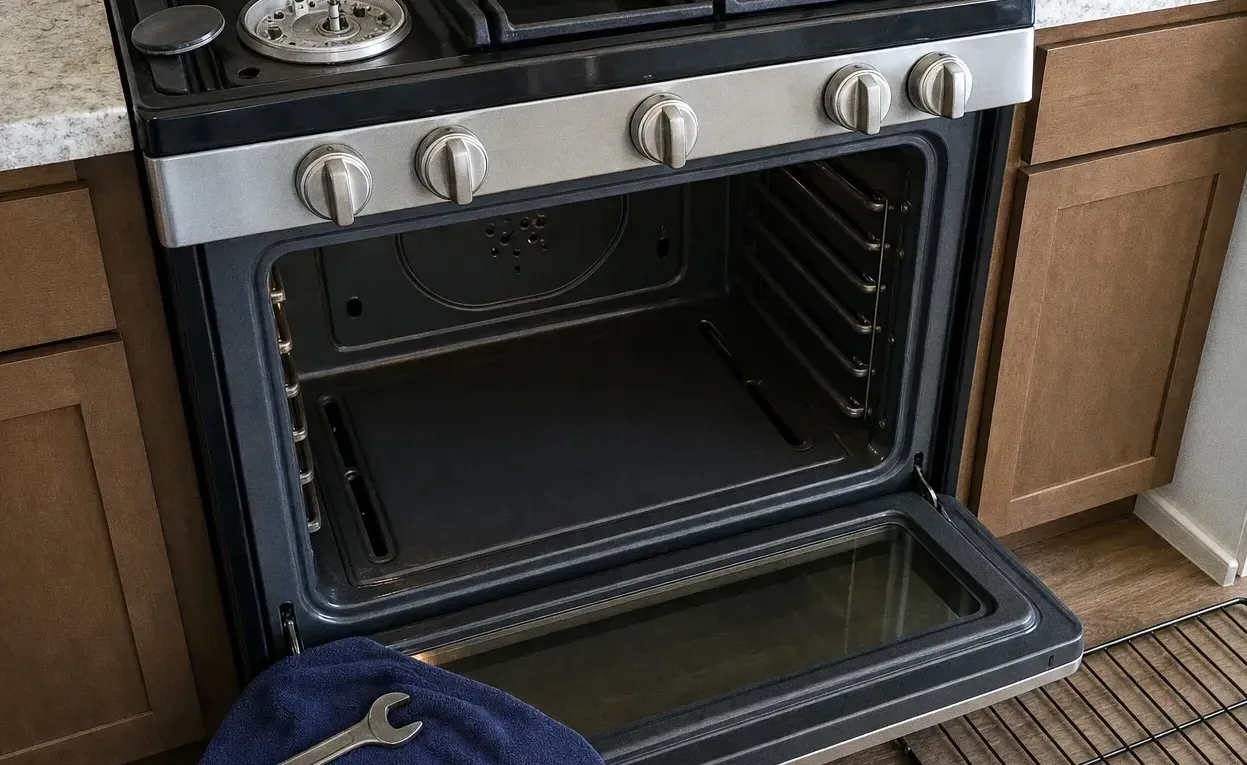
The cycle ran through the evening. It is now the following morning, the kitchen has stopped smelling of scorched grease, the door is cold against the back of your hand — and it will not open. On a good share of these Viking calls nothing is wrong at all. On the rest, the cycle found something that was already marginal and finished it off.
Before you call it a fault, wait properly
The door is not held shut by heat. It is held shut by the control, which keeps the lock set until the cavity reads below the temperature it has been told is safe to open at. That reading is taken continuously, and the lock therefore outlasts the heating phase by a long margin: the burning part of the cycle finishes hours before the release does.
From the kitchen this looks like an appliance doing nothing while remaining, technically, busy. The cooling fan usually keeps running with the heat off, sometimes long after the display has gone back to the time of day. In the open-plan kitchens common in West Newton, that fan is audible from the sofa and gets mistaken for the problem, when it is in fact the best available sign that the electronics are alive and the sequence is still moving.
While you wait, collect information rather than test theories. Is the display lit and showing the time, showing a lock symbol, or showing a code? Is the fan turning? Does the lock indication change at any point? Does the panel acknowledge a press, even to beep and refuse? Note the answers with the time beside each one.
Waiting stops being the answer when the cavity is genuinely cold — cold enough that the door and the surrounding trim are at room temperature by touch — and the lock has not released. Cold metal with a held door means the control is either not seeing the temperature it should or cannot drive the mechanism, and no further patience improves either condition.
Check whether the oven still has power at all
Before anything else, separate two faults that look identical from across the room. A latch that will not release sits in an appliance that is otherwise awake: the clock is there, buttons respond, the fan may still be turning. An appliance that has lost power is dark, silent and unresponsive, and its door is shut simply because nothing is available to move the latch.
If the display is dead, look at the breaker. A built-in oven usually has a dedicated circuit; in Newton Centre and West Newton, where two cavities are frequently stacked into a rear addition, that circuit may be shared between them or split across adjacent poles, so work out which belongs to what before switching anything. Turning the circuit off, leaving it off for a couple of minutes and turning it back on is a legitimate test — what it tells you is whether the control comes back.
If nothing returns, a protective device has very likely done its job. Ovens carry a thermal fuse whose entire purpose is to open the circuit permanently when the compartment exceeds what the design allows, and self-clean is precisely the condition that exposes it. A thermal fuse is one-shot. It does not reset, it does not recover overnight, and it has to be replaced.
None of that is improved by cycling the breaker a second and a third time. If a fuse has opened, the breaker changes nothing. If the breaker itself is tripping, something downstream is drawing current it should not, and repeatedly re-energising a fault is how a small failure becomes a burnt harness.
What the latch is and how it fails
Behind the trim at the top of the door sits a small motor that drives a hook across the door, and a switch that reports where that mechanism ended up. The control does not assume the instruction it issued was obeyed; it waits to be told. Nothing further happens until the report agrees with the command.
That produces two distinct failures wearing one symptom. In the first, the motor never runs — a winding has gone open, or the control is not sending it anywhere — and the hook stays where it is. In the second, the mechanism travels perfectly well but the switch does not confirm it, so the control refuses to believe the door is free and keeps everything shut. From the kitchen the two are indistinguishable; on a meter they are nothing alike.
Heat contributes its own variant. The clean cycle takes the door, its liner and the frame far past normal cooking temperatures and then lets them shrink back, and a mechanism that had barely enough clearance beforehand can bind on the way home. Debris helps it along, since carbonised deposit flakes off during the cycle and some of it lands exactly where the hook travels.
Your part ends here. This is a high-current appliance with a hot cavity, sharp sheet metal and a door heavier than it looks, and the latch assembly is reached from inside the top of the machine. Everything past the observation stage belongs on an Oven Repair call sheet.
What else the clean cycle may have taken with it
The cycle does not damage a healthy appliance, but it does find every marginal component in a single run. Elements close to failing open on the way up. Relays on the control board that switch that load do their hardest work of the year while it runs. Door seals, which spend their lives being squashed, come out of it stiffer and sometimes shrunken at the corners.
That produces the sequence people find baffling: the door releases the next day, everything looks normal, and then the appliance will not hold temperature, or preheats and never announces that it is ready. The two events are related — one cycle, two casualties — and the second is usually easier to diagnose than the first, because a temperature can be measured against a set point.
Residue is a separate matter and mostly harmless. A layer of pale ash on the cavity floor is the expected outcome and wipes out with a damp cloth once everything is cold. What is not expected is a puddle, a heavy tarry smear that never carbonised, or a smell of hot insulation, and any of those is worth reporting rather than wiping away.
The symptoms that end the DIY stage
Three symptoms end it: anything that smells like hot electrics, a breaker that will not stay in, and a door still shut long after the appliance went cold. Any one of them means switching the circuit off and calling rather than trying the next idea.
Do not force the door. The latch is not designed to be overridden by hand, and the effort required to defeat it goes straight into the hook, the strike and the hinges — turning a component fault into a door and frame job, sometimes with broken glass in the middle of it. There is no clever version of this, only a more expensive one.
A visit measures the four things no amount of looking will settle: what the cavity sensor reports against the temperature actually present, what the position switch is sending back, whether the latch motor is being commanded and drawing current when it is, and whether there is still continuity across the thermal fuse. Our service call is $95. Where the finding is a thermostat or a heating element, that work has run $230–$780; where it is the control board or touch panel, $360–$850. We cover Newton Highlands, Newton Centre and West Newton, and the phone number and booking link are already on this page.
Still asked on the phone
Will cutting power at the breaker release the latch?
Sometimes, and only as a side effect. Some controls run a startup routine when power returns and drive the latch back to its rest position on the way through; plenty do not, and a mechanism that is physically jammed will not move whatever the control asks of it. Try it once, leave the circuit off for a couple of minutes, then restore it. If nothing changes, repeating it will not help and may mask a real fault.
Is self-clean bad for the oven?
It is not damaging in itself, but it is the hardest thing the appliance ever does. The cavity runs far above cooking temperatures, and components that were nearly worn out tend to fail during that run rather than later. Used occasionally on an appliance in good order it is a reasonable feature; used as a monthly habit on a twenty-year-old machine it will find every weak part, which is why failures cluster around it.
Should I run self-clean before a holiday?
Not in the days before you need the appliance. If the cycle exposes a tired element or a latch on its way out, you are left with a shut or dead machine at the worst possible moment, with a queue of other households in the same position. Run it well ahead — a fortnight or more — so there is room to sort out whatever it uncovers, or wipe the cavity down by hand instead.